
Teaching AI Agents How to Operate a Cloud: MCP Skills
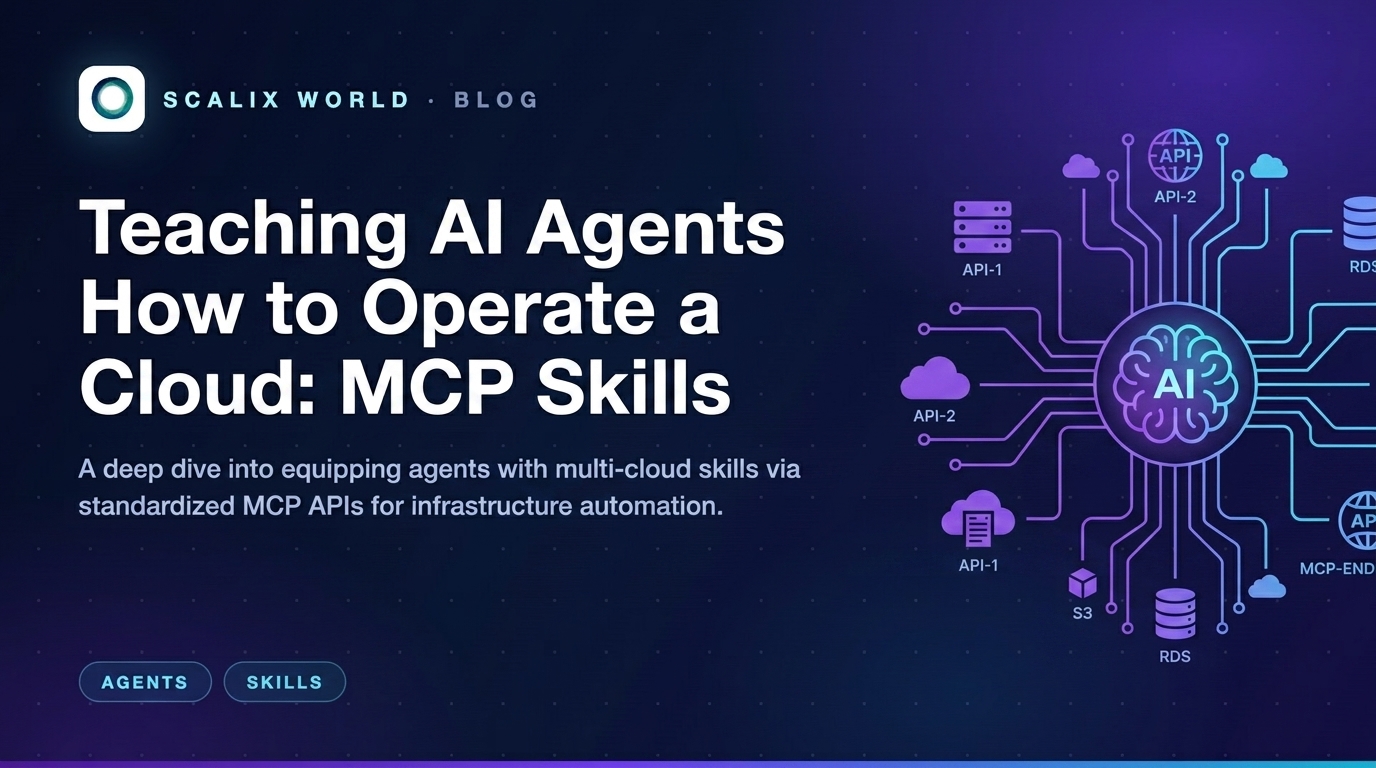
To operate complex infrastructure reliably, AI agents need architectural context, not just API endpoints. MCP Skills provide this context by injecting platform rules directly into the agent’s system prompt. By loading these skills, agents understand the conceptual boundaries of the cloud platform before they ever execute a tool. If the protocol itself is new to you, start with what is an MCP server, then come back for the deep dive.
Giving an AI agent a list of API tools is like handing a junior developer a terminal and leaving the room. The developer might know the commands, but without knowing the system architecture, they will inevitably make destructive mistakes.
When building the Scalix Model Context Protocol server, we realized that 53 tools were not enough. The agent needed to know how those tools interacted.
If an agent does not know that point-in-time recovery requires staying on the same major PostgreSQL version, it will try to run a naive upgrade command and fail. If it does not know that a “sandbox” is exclusively for compute and not for persistent databases, it will hallucinate a database creation flag.
The Architectural Layer: Agent Skills
To solve this, the Scalix MCP server ships with built-in Agent Skills. These are overarching guidelines that the agent loads into its working memory to understand the platform design philosophy.
Currently, the server provides four core skills:
scalix-platform: Teaches the agent about the unified authentication model and the single API key structure. It explicitly instructs the agent never to print or commit the token.scalix-database: Defines ScalixNova serverless PostgreSQL. It gives the agent hard rules: major versions are fixed for the life of the database, and user input must always use parameterised queries.scalix-functions: Explains Node and Python serverless function deployment paradigms.scalix-ai: Details Scalix AI, one OpenAI-compatible inference endpoint with a curated model catalog.
By injecting this context upstream, we stop hallucinations before they start. The agent reads the rules, understands the limits, and writes correct API calls on the first try.
Now Available on NPM
To make this agent-operable surface available everywhere, we are publishing the official Scalix MCP plugin bundle directly to NPM.
You do not need to wait for centralized proprietary marketplaces to approve the integration. Any agent framework that supports standard NPM packages or the generic MCP protocol can connect immediately.
The package is live at @scalix-world/scalix-cloud-mcp.
For clients like DeepSeek Harness, installation is a single command:
dsh plugin --profile web add @scalix-world/scalix-cloud-mcpOther agents like Cursor, Claude Code, and Windsurf can connect via a generic .mcp.json streamable-http configuration pointing to https://api.scalix.world/v1/mcp.
If you are building autonomous systems that need to provision databases, deploy containers, and manage infrastructure reliably, grab the NPM package and give your agent the tools it needs. Learn more at scalix.world.
FAQ
What is an MCP Skill?
An MCP Skill is a set of overarching architectural rules and constraints that an agent loads into its system prompt before executing tools. It prevents the agent from hallucinating capabilities by teaching it the conceptual boundaries of the platform.
How do I install the Scalix MCP server via NPM?
You can install the official plugin bundle directly from NPM using your package manager or agent client. For example, DeepSeek Harness users can run: dsh plugin add @scalix-world/scalix-cloud-mcp.